
Service · Raw materials
Stop carrying it. Start digging it.
The biggest obstacle to living anywhere else is the cost of lifting everything you need off this planet. The answer is to use what is already up there.
The tyranny of the launch pad
Everything you bring, you paid for twice.
One of the biggest challenges facing mankind in the exploration of space is the cost and the energy needed to move goods from our home planet to space, and then on to the worlds beyond.
Every kilogram of steel, water, air and fuel that leaves Earth has to be pushed out of the deepest gravity well anyone will deal with for a very long time. Then it has to be slowed down again at the other end. The fuel to do that has mass too, and that mass needs its own fuel.
Run that arithmetic against a habitat that needs shielding measured in tonnes and the answer is not "launch more rockets." The answer is to stop launching material you are standing on.
What is already there
More than most people expect.
Oxygen
Lunar regolith is roughly 40 to 45 percent oxygen by mass, locked up in metal oxides. Get it out and you have air to breathe and oxidiser for propellant.
Metals
Iron, aluminium, titanium and silicon, in the same regolith. Structure, wiring, solar cells and tools, without a single launch.
Water
Ice in the permanently shadowed craters at the lunar poles. Water is drinking, growing, shielding, and split into hydrogen and oxygen it is fuel.
Regolith itself
Before you refine anything, the raw dirt is radiation shielding and construction material. Sometimes the answer is to pile it up.
Where we come in
The machine that gets it out of the ground.
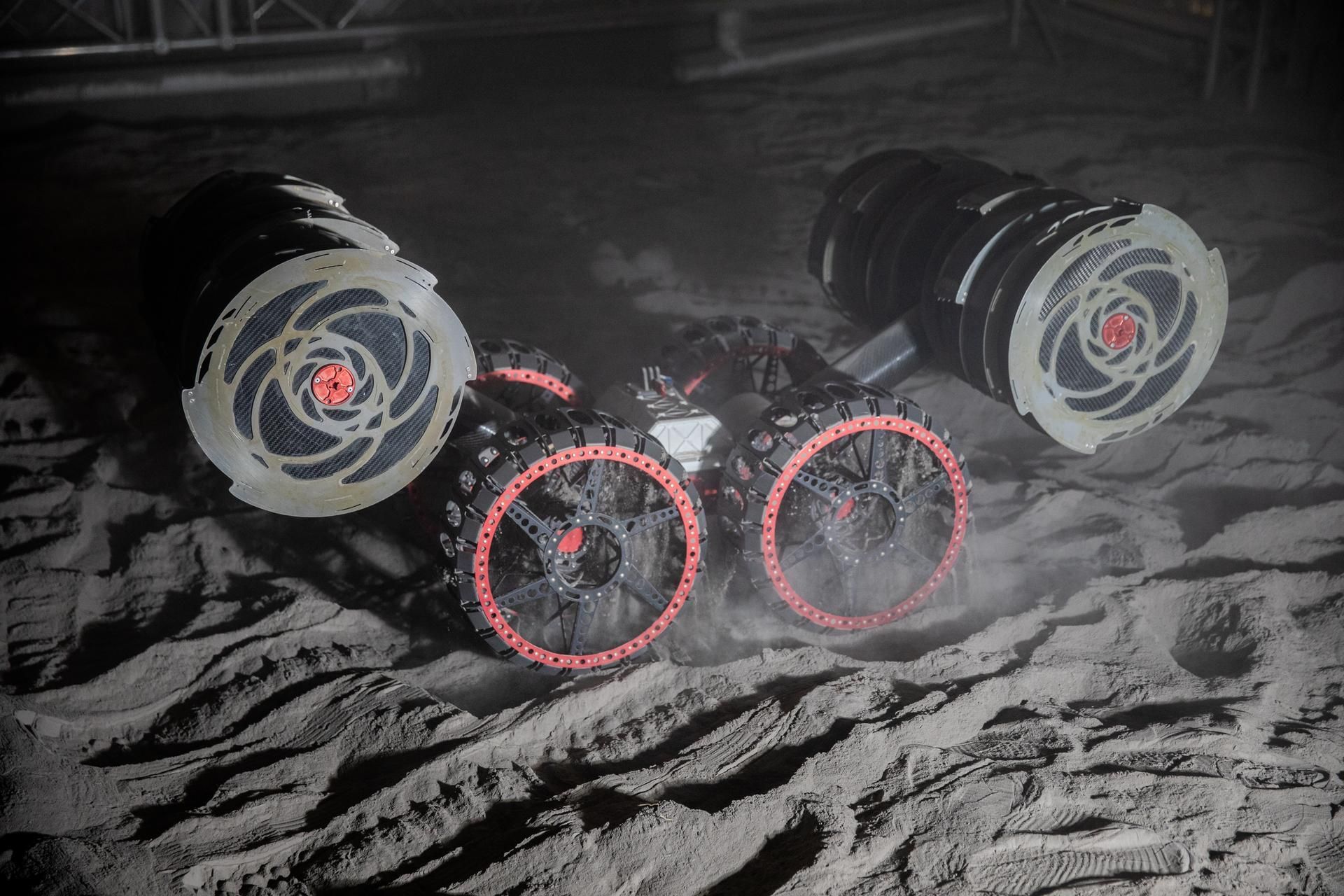
Extracting resources is a chemistry problem. Getting to them is a machinery problem , and that is our end of it.
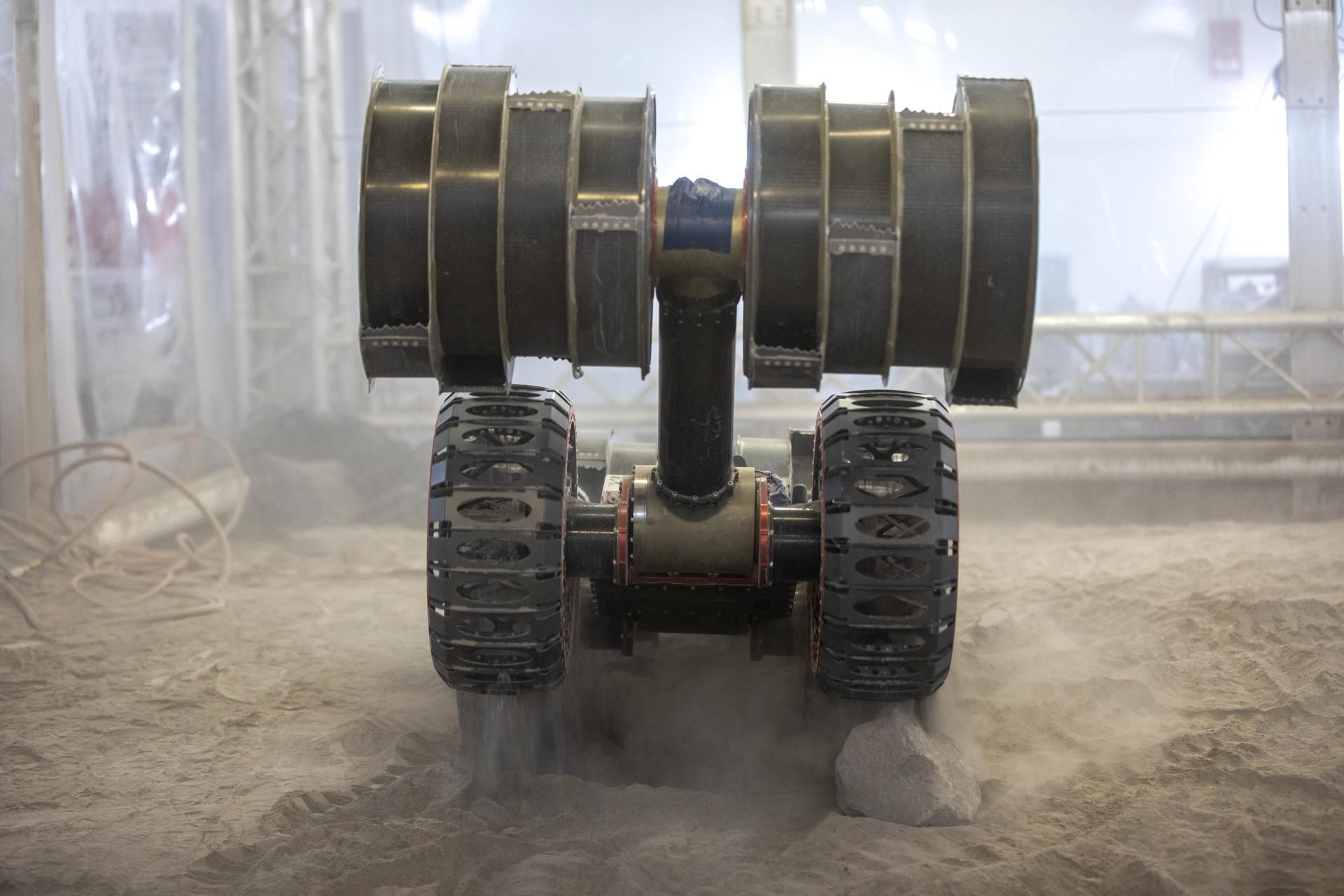
Excavation in low gravity is genuinely difficult and not intuitive. On Earth a digger uses its own weight to force a bucket into the ground. At one sixth of a gee that weight is mostly gone, so a machine that digs hard simply pushes itself away from the work.
The answers are counter-rotating cutting drums, anchoring, clever geometry and a great deal of testing. Our drive wheels come from exactly this problem: get traction on loose regolith and the rest becomes possible.
What a foothold needs
The reason this is the first service on the list.
Land and survive
Everything comes from Earth. Expensive, fragile, and finite. This is where every programme is today.
Make oxygen and water locally
The first loop to close, because it is the one that runs out fastest. This is where a settlement stops being a visit.
Make structure locally
Shielding, pads, roads, berms. Bulk material moved and placed by machine, using dirt that was already there.
Make propellant locally
Split water into hydrogen and oxygen and the Moon becomes a filling station instead of a destination. Everything past that point gets cheaper.
We are working on the machinery for phases two and three. We are not claiming to have solved them, and nobody else has either — that is precisely why it is worth working on.
Raw materials
The shovel comes before the settlement.
If you are working on the same end of this problem, we should talk.