
Picayune, Mississippi · Est. 2021
Somebody has to build the shovels.
Every nation and company racing back to the Moon needs the same unglamorous things: machines that dig, machines that build, and people who can fix them. Hephaestus Industry is being built to do the dirty work of the new settlements.
The premise
Since we found fire, we have adapted.
Mankind has learned to live everywhere this planet has thrown at us — ice, desert, ocean, altitude. Now we are reaching for somewhere as unfamiliar as it is hostile, and the same problem comes back around: you cannot carry everything with you.
Lifting a kilogram off Earth costs a fortune in fuel and energy. Lifting the millions of tonnes a permanent settlement needs is not a budget problem, it is a physics problem. The only way through it is to stop carrying and start using what is already there.
That is the whole thesis. Water, metal, oxygen and building material are already sitting on the Moon, on Mars, and out in the belt. Somebody has to build the machines that get them out of the ground. We would like it to be us.
Where we actually are. Hephaestus Industry is a small company in Picayune, Mississippi, founded in 2021. We are designing hardware, cutting parts, and filing patents on our own ideas. We have not flown anything yet, and we say so on every page of this website rather than let anyone assume otherwise. Everything described here is what we are building toward.
What we are working on
Three problems, in the order they bite.
Raw materials
Getting metal, water and oxygen out of regolith so a settlement does not have to wait on a resupply launch from Earth for every bolt and every breath.
Raw materialsHabitat & construction
Shelter once people arrive. Machines that grade, move mass and build with what is under their tracks, in gravity that behaves nothing like ours.
ConstructionSustainable systems
Making a new home somewhere people can actually stay. Closing loops rather than consuming a stockpile and hoping the next ship is on time.
SustainabilityWhere the work is
Four places. Four completely different fights.
Machinery does not care about romance. It cares about gravity, temperature, dust and how long help takes to arrive. Those numbers change everything about how a shovel has to be built.
A day lasts 29.5 Earth days, so a fourteen-day night has to be survived, not waited out. Regolith is sharp, statically charged and gets into everything. First stop, and the hardest teacher.
A day almost exactly like ours at 24 hours 37 minutes. Enough atmosphere to carry dust storms and not enough to breathe. Round-trip radio runs from four to twenty-four minutes, so machines have to think for themselves.
Gravity almost like home, and a surface at about 465 degrees Celsius under ninety-two atmospheres. Nothing we have built has survived down there for more than a couple of hours. The cloud tops are another matter.
Ceres alone holds more fresh water than every river and lake on Earth. Gravity so slight that anchoring matters more than digging, and a machine that pushes too hard simply launches itself.
The hardware
Steel we have actually cut.
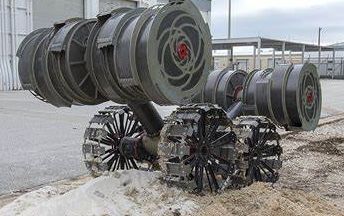
We are not writing white papers. We are designing parts, cutting them, and finding out what breaks.
Some of it gets cut in house on our own machines and some gets ordered in while we build up capability. Every month a bit more of it happens on our own floor.
Drive wheels for loose regolith are where we started, because nothing else matters if the machine cannot get traction on a surface that behaves like powdered glass.
The people part
This will need hands, not just ideas.
When this equipment launches, it will need technicians. Quite a lot of them.
Operators here on Earth running machines a quarter of a million miles away. Technicians who build, test and qualify hardware before it ever leaves the ground. And eventually technicians who go up and fix the things that break where nobody can reach them.
None of those roles are open yet. But we are keeping a list, and when they open the list is where we will start.
Straight answers
The questions people actually ask us.
Have you launched anything?
No. We are a design and prototype stage company. We are building hardware on the ground, filing patents, and getting ourselves ready to be useful to the organisations that will be flying missions. We would rather tell you that plainly than dress it up.
What does Hephaestus actually make?
Right now: drive and excavation hardware for low-gravity surfaces, and the designs behind it. Our starting point was one piece of NASA technology, and we have been building outward from it.
Are you hiring?
Not yet, and we will not pretend otherwise. The careers page is a list of people who want in when the roles open. It costs you two minutes and it is genuinely how we will hire.
Can I invest, or work with you?
Talk to us. We are a small company with a lot to do and we are open to partners, suppliers, and people who know something we do not.
Why the name?
Hephaestus was the smith of the Greek gods. He made things, in fire, for other people to use. That is the job.
Next
This is going to take more people than it has.
Whether you want to build the machines, run them, repair them, or just follow along and see whether we make it — there is a door here.